Choosing a managed time series database for your IoT or DevOps workload usually comes down to one nervous question: am I paying for performance, or just paying?
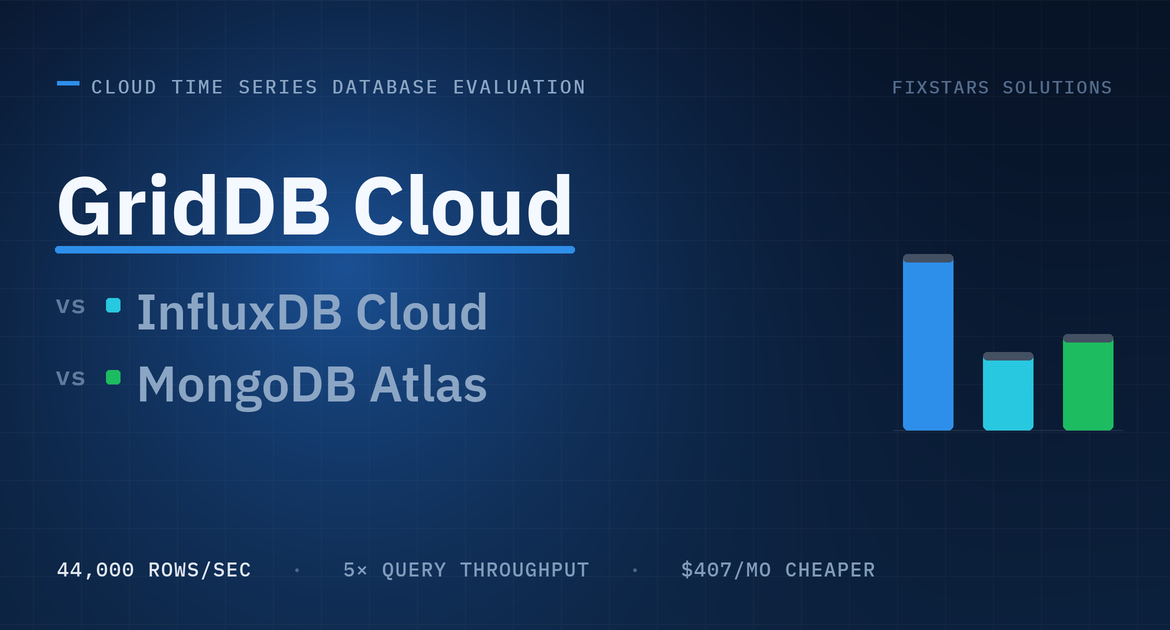
So we put three of the most popular options head-to-head: GridDB Cloud, InfluxDB Cloud, and MongoDB Atlas, using the standardized Time Series Benchmark Suite (TSBS). Same workload, same methodology, real ingestion and query numbers. Below are some of the more interesting findings.
1. At the pay-as-you-go tier, GridDB Cloud and InfluxDB Cloud cost exactly the same. Identical rate cards, so performance becomes the only tiebreaker. GridDB delivered 4–5× higher query throughput at 4–5× lower latency.
2. InfluxDB choked on large batches. A 100,000-row batch threw 429 Too Many Requests errors instantly. GridDB sailed through the same load at roughly 44,000 rows/sec.
3. MongoDB Atlas M40 costs $407/month more than GridDB’s fixed plan — and lost every benchmark. On threshold-scan queries at 64 workers, GridDB ran about 10× faster.
4. GridDB scaled. The others hit a wall. InfluxDB capped out near 11.5 queries/sec; MongoDB plateaued at 32 workers. GridDB kept climbing past 64.
Putting it all together, we can confidently say that there’s a GridDB Cloud pricing model that beats the competition whether your workload is bursty and variable or heavy and continuous.
The full methodology, ingestion and query tables, architecture diagrams, and the per-query breakdowns behind every number above can be found in the whitepaper. Take a look now!